Monday, March 14, 2016

Historians Should Try to Talk to People Who Aren't Historians

People tell me I need to stop using such academic language in my writing. I need to write in a way that people will understand. Sounds like a good idea! My wife tells me this. So does my sister. Pretty sure my mother-in-law has made this suggestion too. And they're right! And believe it or not, I'm trying! I'd like to think the difference between what I'm getting in and what I'm putting out is significant. For example, here are a couple sentences from a book I just sat down to read:
I argue that the settler colonial situation establishes a system of relationships comprising three different agencies: the settler coloniser, the indigenous colonised, and a variety of differently categorised exogenous alterities. In this context, indigenous and subaltern exogenous Others appeal to the European sovereign to articulate grievances emanating from settler abuse, the metropolitan agency interposes its sovereignty between settler and indigenous or subaltern exogenous communities (establishing “protectorates” of Aborigines, for example), and settlers insist on their autonomous capacity to control indigenous policy.
Great! Glad we got that cleared up. And here's the main point from another book today:
Bringing a postcolonial perspective to urbanizing colonial environments, this book explores the racialized politics of these two settler-colonial landscapes at the spatial, imaginative, social, and legal levels and in a comparative context. More importantly, it examines the racialized transformations of these developing cities and proposes that these urbanizing colonial precincts can be viewed as formative sites on the Pacific Rim, where bodies and spaces were rapidly transformed and mutually imbricated in sometimes violent ways, reflecting the making of plural settler-colonial modernities. 
Great! So good to know about that mutual imbrication. So you see, I'm trying. And I will get better at it, I hope.

Sunday, March 13, 2016

Could an Anti-Racist Win the Republican Nomination?

In recent years I've stopped publicly critiquing the Republican Party's racism. I stopped for several reasons. Most important, I've come to believe that White supremacy in the United States is not primarily a partisan problem. It takes two to tango. And our politics are a reflection of deeper power-relations and social structures. Pointing out the racist foundations of the modern GOP is like shooting fish in a barrel. I think many scholars are bored of it at this point, and they have increasingly turned their attention to the racism of the Democratic Party. Historians have uncovered the contradictions and failures of postwar American liberalism and have shown how liberalism has helped to construct and maintain colorblindness and White supremacy. For example:

Naomi Murakawa. The First Civil Right: How Liberals Built Prison America

Leah Gordon. From Power to Prejudice: The Rise of Racial Individualism in Midcentury America

Reuel Schiller.  Forging Rivals: Race, Class, Law, and the Collapse of Postwar Liberalism

Daniel Martinez HoSang.  Racial Propositions: Ballot Initiatives and the Making of Postwar California

Daryl Michael Scott. Contempt and Pity: Social Policy and the Image of the Damaged Black Psyche, 1880-1996

Yet it would be naive to suggest that racism is an equal problem in all political parties at all times. Even though no major American political party has ever been willing to stand unequivocally against White supremacy, at various times one or the other party tends to be the lesser of two evils. The Democratic Party circa 1864, for example, was a worthless and execrable institution, while the Republican Party, despite its inability to imagine real equality, at least wanted to end slavery. 

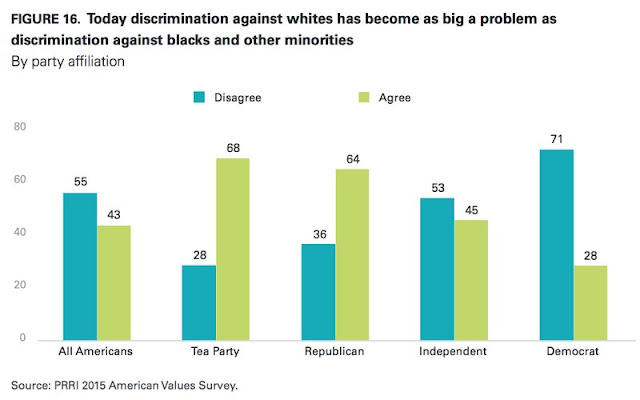
Even if scholars are a bit bored of the fact that the contemporary Republican Party is racist in a way that the Democratic Party is not, the reaction to Donald Trump's rise is a reminder that what is common to knowledge to us is not necessarily well-known to the public. So perhaps we do need to speak up. First, let's just establish the point that the GOP has a severe problem with racism:
There are dozens of data points we might offer as evidence, but I think this is one of the best. It's a simple statement, easy to understand, and because you have to  deny reality in order to agree with it, it's an effective proxy for measuring racial ignorance and racism. Notice, again, that this is a bipartisan problem. Nearly a third of Democrats agree with the statement. But you can see that Republicans have a much more severe problem. Nearly two-thirds embrace a view of American society that is intellectually and morally unsupportable.

You can see this by many other measures too. For example, even attitudes toward interracial marriage have a partisan gap. I'll just note one more. The racial resentment scale that many political scientists use shows how white resentment has become less bipartisan in recent decades and has become increasingly concentrated in the Republican Party.
My intention is not to beat up on the Republican Party. These partisan differences have ebbed and flowed over time. But we do need to grapple with where the problem predominantly exists right now.

I raise this point because I'm concerned that though most Republicans desperately want to stop Trump, they don't appear to have a plan to build their party anew on a less racist foundation. Even now, amid all the denunciations of Trump, the other candidates continue to play to the racism of the base. To understand this, we need to pay attention to what they're not saying.

A few weeks ago, when Marco Rubio finally decided to attack Donald Trump, he got down in the gutter with him, making jokes and personal attacks. He justified this on the grounds that policy attacks didn't seem to stick, and it was the only way to get the media to pay attention. He didn't want to do it, but it was the only option he had, right?

In fact, there has been another attack available to Rubio, Cruz, and Kasich all along, and they could make it without descending to Trump's level or engaging in crude insults or name-calling. This particular attack would also have the virtue of being true. Most important, if made forcefully and unequivocally, this attack would have dominated the news and made headlines for Rubio's campaign. It would go something like this:
"Donald Trump is using racism and bigotry to win votes. It doesn't matter to me whether Donald Trump is a racist in his heart, or is merely playing one on TV. His words are a disgrace to our party and our country, and it is an embarrassment to share a stage with him. I denounce his racism and will campaign against him if he were to be the Republican nominee." 
This would have been the appropriate response from the beginning of Trump's campaign. Remember, he was the most famous provocateur of the birther movement. Then he launched his campaign by calling Mexicans rapists. The other candidates should have pursued this line of attack at the first Republican debate. The point is, if the GOP was as innocent as its leaders claim, this would not have been a hard attack to make! There wouldn't be any downside. But the other candidates can't make this attack because, in the end, they need Trump's voters! And they know that most Republicans, including a substantial number of their own supporters, believe Whites are the primary victims of racism. They know that speaking bluntly against racism will not be received positively by most Republican voters.

The problem is deeper than Trump. And though the Democrats are not as egregious, they have their own problems. The front-runner has expressed her utmost confidence in Rahm Emmanual. She and Bernie have to be pressured and cajoled to support basic justice for people of color. Because so many people of color are in the Democratic coalition, there is a moderating effect. Even though Democrats don't dare to run on an explicit platform of tearing down White supremacy, they do have to be somewhat attentive to minority concerns. In the nearly all-White GOP, the moderating effect is almost non-existent. What Trump shows is that it may be possible to win the Republican nomination while running as a racist. Is it possible to win the Republican nomination while running unequivocally as an anti-racist? None of the other candidates have dared to test that proposition.

Wednesday, March 2, 2016

What's Next In A World Where Donald Trump Can Win?

A few preliminary thoughts on the state of our country:

There are at least three important stories here, and it's hard to sort out how they interact with each other.

1) Donald Trump is a distraction from the real sources of contemporary racial injustice and inequality. The flap over the Ku Klux Klan is a classic case of denouncing the villains of the old order so as to establish one's innocence in the new order. Denouncing the Ku Klux Klan (which we should do of course!) has very little meaning because the Klan is not a key force constituting the contemporary racial order. When we denounce the Klan, we're actually not saying much of anything about our stance toward current racial injustice, any more than early twentieth segregationists who denounced slavery were implying opposition to Jim Crow. On the contrary, shutting the door on the old order helped to consolidate the new. In the same way, the question for Donald Trump and all American politicians is not whether they denounce the Klan--a group that had significant social power in the old racial order but does not have such power now--but whether they denounce the contemporary forces that undergird present-day power relations. The Klan plays a negligible role in contemporary racial injustice, but colorblind ideology is a vital support for present-day White supremacy. In American political life, we denounce the former so as to bolster the latter.

Do you denounce the forces that create and sustain racial injustice now? Do you even know what they are? By that standard, nearly all politicians of both parties fail. 

Denouncing colorblindness, exclusionary zoning, and supreme court school desegregation precedents is much more meaningful and important than denouncing the Klan. Politicians across the spectrum are failing to do this. While we beat up on Trump for being a racist (and he is), there is a danger that we lose sight of the bipartisan investment in racial injustice that shows little sign of abating.

2) On the other hand, sitting quite uncomfortably next to what I have said thus far, there is a real danger that Donald Trump will bring back into the American mainstream a kind of classical racism that we haven't seen in decades. He has already brought an explicit racist populism into the national political sphere in a way we haven't seen since George Wallace. And even Wallace was never this close to winning the Democratic Party nomination. It is hard to quantify the costs of reopening the door to 1960s-style racism, but they surely include these possibilities: an uptick in hate crimes and racial violence, a degrading of our civic fabric, and a heightened sense of fear and alienation among people of color. Indeed, this last possibility is especially concerning. Imagine how it must feel to see a figure like Trump winning state after state in a major party nomination, knowing that there is no room for people who look like you in his vision of national greatness, and discerning, especially, the undercurrent of violence he threatens to unleash. This is very serious.

I'm not sure how to make sense of these two threads together--Trump as distraction from contemporary systemic racism vs Trump as resurrector of classical racism--but I think they're both happening at once and it will take a while to figure out how they relate to one another.

3) The third story is the decline and fall of the Republican Party. I can't escape the conviction that if the GOP had made a sincere effort during the Obama years to be more than a White party, it could have inoculated itself against Trump. As Adam Serwer wrote in an excellent piece months ago, Republicans have been unable to neutralize Trump because all the groups he insults are already outside the party anyway. Republican elites may deplore Trump's demagoguery, but they built a political coalition ready-made for it. Those of us who have been sounding the alarm for years can claim some sort of vindication here, but it's not particularly satisfying, especially since it's not at all clear anti-Trump Republicans will learn the lesson of the last few decades.

The roots of this go deep. At the presidential level, the GOP won the 1960s-1970s battle for southern Whites. People forget now that Democrats went hard for southern Whites too in the 1970s, and Jimmy Carter campaigned with White supremacists while feigning ignorance about it. But the GOP won that battle with the Reagan Revolution and have solidified their hold ever since, extending their reach down to every state legislature, with the key breakthrough coming in 1994 and culminating in 2010-2014. They captured southern White conservatives, but were in the process captured by them. Along the way, party elites have embraced absurd ideas about the nature of the respective partisan coalitions. There was Mitt Romney in 2012, both before and after the election, claiming that Obama won by giving "gifts" to various groups, as if Obama's strategy was different in kind from Mitt's pitch to White retirees. Last year there was the great establishment hope, Jeb Bush, proclaiming that he would not offer "free stuff" to Black voters, while refusing to say the same to the people who most need to hear it. The GOP has constructed an entire mythology of racial innocence that is unmoored from any facts or reason. Will the GOP use the occasion of Trump's rise to seriously grapple with what they've built? Or will they persist in portraying Trump as an inexplicable cancer?

More than that, will the country, will both parties, use Trump's rise to reflect on the kind of injustice we now tolerate or celebrate all around us? I'm returning now to my first point. It is well to remember that the 1890 Mississippi constitution--the crowning edifice of White supremacy after the turmoil of Reconstruction, the document that set the legal foundation for Black disfranchisement and three generations of Jim Crow oppression--was colorblind! Think of that for a moment. I bet you didn't know that Jim Crow in Mississippi, the prototypical American example of old-time racism, was established on a foundation of colorblindness. And in the decades since the civil rights movement, we have returned to colorblindness with a vengeance. We condemn the segregationists of the 1960s even as we happily live in the world they did so much to create. As the historian Joe Crespino wrote in his book on Mississippi:
In looking back over the half century since the civil rights movement, white Americans have hardly repudiated the vision of social organization advocated by Mississippi segregationists, at least if the measurement is not words but rather the actual composition of American neighborhoods and schools. Perhaps it is most accurate to say that since the 1960s, white Americans--from rural Mississippi to the most cosmopolitan communities in America--have practiced their own form of 'practical segregation.' They have rejected the ugly white supremacy of the Citizens' Council, but implicitly and explicitly they have embraced the quiet protectionism that preserved the racial and class privilege of suburban America. The closed society may have been defeated, but most American suburbs today are a world that hard-line segregationists would have little problem with.

Sunday, February 21, 2016

Donald Trump and the Crisis of White Identity

As Donald Trump has gone from a bad joke to a potential president, we need to think more seriously about the nature of his appeal. One school of thought says that White working class voters (more on this problematic label later) are supporting Trump because they have seen their economic prospects decline. Wages have stagnated for over a decade. Jobs were lost in the great recession that are never coming back. The hardship is real. But the way the media talks about Trump's supporters has the unintended effect of making excuses for White racism. Trump's followers have "economic anxiety" the pundits intone, as if this explains why they would find racism and bigotry appealing, as if economic setbacks are naturally greeted with cultural resentment and wild cheering for a mean-spirited demagogue. The unstated assumption is that when Whites face economic hardship much less severe than what people of color have faced decade upon decade, it is understandable--perhaps even reasonable!-- for them to lash out.

Measured by standards of White economic prosperity, Black Americans have faced an economic depression for...several centuries. Why have Black Americans failed to build large political movements in support of demagogues? Imagine a Black demagogue winning primary elections while calling Whites rapists, demanding a ban on White immigration, and excusing his supporters as they beat up White protesters. I ask you to seriously imagine it, because it's a revealing counterfactual. Would the media chalk it up to "economic anxiety" and "controversial" talk? The media framing of Trump's racism as a "tell it like it is brashness" reflects our basic familiarity and comfort with White racism. Trump doesn't necessarily strike fear into the heart of the White mainstream because it is not, after all, his target. And we who are White know this. We are in the majority. If Trump becomes president, we know we will not be in the firing line. Trump's supporters love him because he validates their Whiteness. Ironically, his detractors unconsciously draw on that same Whiteness as we fail to denounce him with the moral urgency his rise demands. 

To be clear, the economic anxiety narrative makes a lot of sense on its face. After all, the economic problems are real enough. Not only that, Trump has substantive differences with GOP orthodoxy that may draw voters to him. There are lots of Republicans who favor more protectionist trade policy, less immigration, and robust welfare programs for the elderly. Trump offers them this policy mix, while other Republican politicians traditionally do not. But it is irresponsible to discuss these factors without accounting for the crucial--indeed, decisive--way White identity intersects with and animates these issues. The economic anxiety narrative actually fails to explain what is most in need of explanation: why should stagnant wages make racism, bigotry, and plain mean-spiritedness more appealing? Many people, myself included, have marveled at the stickiness of Trump's support. It seems as though he can say almost anything and retain the allegiance of nearly a third of Republican voters. This is because Trump's campaign is at bottom an appeal to identity.
Characteristically conflating nationalism and White supremacy, Klan members march in the nation's capital. 1925.
What Trump's ascendance reveals, and the economic anxiety narrative fails to grapple with, is the underlying crisis of White American identity. Forged in conquest and enslavement of others, fortified in exclusionary campaigns for political, economic, and social supremacy, White identity retains implicitly many of the assumptions of its creation. Implicit in White identity is an entitlement to success. Yet many White Americans are not successful. And the oppression that created the entitlement is no longer socially acceptable. Even the currency of the "psychological wage" of Whiteness that Du Bois famously wrote about seems to have depreciated in value. For most of American history, even the poorest Whites could act out their sense of superiority over Black Americans, from the commonplace--calling a Black man "boy"--to the extraordinary spectacle of lynchings attended by thousands. In a post-civil rights movement society where equality and freedom for all is our publicly-avowed ethic, White identity is unmoored from its founding logic. Yet no coherent mass White identity has emerged to take its place. Perhaps more than ever before, we don't know how to understand a society where two things at once are true: Whiteness is advantaged, and millions of White people live in poverty and despair.

There are nineteen million poor White Americans, the census bureau estimates. Yet our popular media and cultural narratives have no room for them. We can't even talk about them. Poor Whites are "working class" or "blue collar." They are not poor. Why? Because to be poor is to contradict the basic narrative of Whiteness. To be poor and Black is to be a stereotype. To be poor and White is to be beneath one's (entitled) station. To be poor and White is to be ridiculed, yes; but more than that it is to be ignored altogether. When the anthropologist Kirby Moss launched a project to study poor Whites in a Midwestern city, people encountered him with surprise and confusion. Not only did they assume he would be White, they assumed that an anthropologist studying urban poverty must be studying Black people. Revealing, isn't it?

In his book, The Color of Class: Poor Whites and the Paradox of Privilege, Moss argued that poor whites are basically invisible in the public representation of Whiteness. They exist in an anomalous position: while their material lives are shaped by poverty, their identities are tied to Whiteness, which is not associated with poverty (except in certain specific tropes tied especially to the South and Appalachia). We desperately need a Whiteness that has room for them, a Whiteness in which success is not a birthright, where solidarity is more important than hierarchy, where poverty is not stigma, and where the self-serving fables of the rich are not accepted as sober economic analysis. In short, we need nothing less than the abolition of Whiteness as we have known it. Instead, the political mobilization around Donald Trump is encouraging Whites to double-down on our legacy of exclusionary political movements. It invites us to return to that great White myth: that success is a zero-sum game, that greater opportunities for others mean less opportunity for us.

We must be honest about the history by which we became White. The peoples who became White in the United States forged their collective identity in contexts of supremacy. One of our nation's first laws, the Naturalization Act of 1790, declared that only White persons could become naturalized as citizens. Whiteness became associated with so-called civilization, with manliness, with the ability to deploy the labor of others, to own land, to prosper, with American nationalism itself. Even if one did not own land or employ others, one could hope in the boundless potential of free White labor. According to civil war-era Republican ideology, the common (White) man would rise by the fruits of his labor, untainted by Black slavery. Southern White Democrats, demanding a Whiteness that used rather than excluded Black labor, fought back against Reconstruction with paramilitary violence and terrorism. Whites on both sides of the Mason-Dixon line came to believe that Reconstruction had been a disastrous experiment in Black empowerment. Driven in part by their shared commitment to White supremacy, they reconciled after the bitterness of civil war. The decades around the turn of the century saw Whites mobilizing in nativist campaigns against the mass immigration from Eastern Europe of people of questionable Whiteness. In the first decades of the twentieth century, White middle class progressives sought to remake the country in their image, offering assimilation for some and racist eugenics for others. In the 1920s the Ku Klux Klan was reborn as a national organization with millions of members. Mixing White supremacy, American nationalism, and Protestant Christianity the 1920s Klan exemplified the powerful conflation of Whiteness with other values that has characterized much of American history. White political movements have run the gamut from exclusionary to assimilationist. They have seldom been liberatory.

In contrast, the various peoples who became Black in the United States forged their collective identity in contexts of oppression. It was and is an identity characterized by narratives of resistance, resilience, and solidarity. We're all in this together. Even if these tropes operated at the level of myth more often than not, they became powerful tools of cultural and political mobilization. Black political movements have been rooted in the specific challenges African Americans face, but they have tended to promise enduring benefits to the entirety of America. From Reconstruction to the Great Migration, the civil rights struggle, and Black Lives Matter, movements grounded in the particular problems of Black Americans have offered visions of greater justice and opportunity for all Americans.*

The meanings of race, and the boundaries it imposes, have always been unstable. Whiteness has grown to encompass more groups and what it means to be White has continually changed. We are not doomed to endlessly repeat our legacy of exclusionary political movements. We can learn from the Black political tradition. And we can remember the minority of Whites at every historical moment who resisted the dominant investment in Whiteness in their time. As the meaning of race and racism transform once again in our own time, we have the opportunity and the responsibility to build a new Whiteness. As George Lipsitz has written, if we do not actively cultivate an anti-racist White identity, we will be consumed by our investment in a White identity that is inherently destructive.
____________

*Black nationalist and radical traditions, from Henry McNeal Turner to Marcus Garvey to Black Power, might at a glance seem to defy the narrative of an inclusive Black political tradition. But we must draw a sharp line of distinction between political mobilizations designed to oppress a minority group, and those minority groups' efforts to respond to their exclusion from the dominant society. Black nationalism has played an important and necessary role in resisting oppression.
Monday, February 1, 2016

Donald Trump and the Course of American Conservatism

Donald Trump may win Iowa tonight. It remains to be seen whether he can win the nomination. But he has already emerged as a far greater political force than anyone imagined when he announced his candidacy last summer. In the process, he has unleashed passions that profoundly unsettle me and nearly everyone I know, conservative and liberal alike. We ask ourselves, do we really know our own country? Is bigotry and mean-spiritedness really so popular? Could an authoritarian demagogue really rise to the presidency? Here, in the United States? Time will tell.

I've read dozens of conservative writers make their case against Trump. They are horrified by him. So I can't help but ask, where have they been for the past two decades while the conservative movement has accepted or excused all manner of bigotry and falsehood? When did they confront the proud racism, misogyny, and homophobia of Rush Limbaugh, the apocalyptic paranoia of Glen Beck, and the lies of pseudo-historian David Barton? Where were they when a cable channel full of ignorant pundits stoking racial resentment became conservatism's premier news source? Oh, I guess many of them were too busy making sure they had a seat at the table.

The very same publications that have attacked Trump have also run articles accusing President Obama of purposely destroying America. Marco Rubio has now started saying this! It's no longer enough to say that you disagree with the President. Conspiracy theory has become common sense, and basic facts have become liberal bias. What's the message here? Trump is bad, but Trump-lite is ok?

People are wringing their hands about Trump's bigotry, constant falsehoods, and outlandish rhetoric, as if it's in any way different from what you can hear on talk radio every single day. It's not different. Is it really so surprising that a political figure has emerged to provide conservative voters a choice that echoes the views of their most popular news sources? After conservative elites have refused to say in clear terms that bigotry will not be tolerated, that figures like Rush Limbaugh are not welcome in the party, they are shocked--shocked!--that a candidate is so powerfully channeling the cultural resentment that is Limbaugh's bread and butter.

Many conservative pundits and politicians are acting as though they are not complicit in Trump's rise. But the party has been playing with fire for years. Look at the last two presidential election cycles. The jovial ignorance of Herman Cain. The routinized lying of Michele Bachmann. The cultural resentment and white identity politics of Sarah Palin. All of these unqualified figures were beloved by evangelicals in their moment, and tolerated by party elites. Trump launches a campaign of their greatest hits, and now the party suddenly realizes the downside?

Though Trump is a dangerous man, there is still time for good to come from his rise. It will start with this realization: if you don't like Trump, you actually don't like much of modern American conservatism. This doesn't mean you're not a conservative. It doesn't mean conservatism isn't valuable and absolutely needed. In many ways, I am deeply conservative. I hear the word revolution and I run the other way. Because to be a conservative is to understand that, actually, it could be worse, and change must be implemented carefully because there are always unintended consequences. In many ways--believe me, I'm not trolling, and I don't yet know who I am supporting this year--Hillary Clinton offers a more philosophically conservative vision than do many of the Republican candidates.

I believe Trump's demagoguery will pass and there will be a better and more responsible conservatism in the nation's future. But that might not begin until we face the fact that Trump is not a weed in the garden of contemporary conservatism. He is its fruit.