Showing posts with label racism. Show all posts

Wednesday, October 12, 2016

The Radicalism that Enables Trump

Human beings are complicated creatures. Many Trump voters are probably more upstanding in their personal character than I am. Yet, as a collective political force, Trumpism represents the barbarian horde at the gate. If they break through, it's not clear our civic institutions can withstand the damage.
The Course of Empire -- Destruction. Thomas Cole. 1836
Trump is the warlord leading this frenzy, but he did not start it.

A growing sense of fragmentation in our society and declining trust in our institutions are broad-based, bipartisan, and long-term phenomena, as Daniel Rogers has shown in his book, Age of Fracture.

But the radical conservative movement (a contradictory phrase) has deliberately catalyzed this disintegration. Stoking fear and paranoia, an alternative media apparatus has joined with radicals in congress to tell Americans that science is a hoax, that academia is a secular cesspool, that mainstream media is too biased to have any use, and that the Democratic Party is trying to destroy the country. Now, in the internecine conflict of the Republican Party, we see the radicals eating their own. There is no natural end point to this orgy of destruction.

Last night on Twitter, Matthew Yglesias wrote, "My guess is that in a Trump administration angry mobs will beat and murder Jews and people of color with impunity."

If you're familiar with Yglesias, you know that he is frequently snarky and ironic. So in this case, I assumed he was joking. He wasn't.

If you're not tuned in to political twitter, you might not be aware of what I'm about to tell you. Jewish journalists and journalists of color are being bombarded daily with genocidal racism from Trump supporters. I won't repeat the depravity here. But these journalists have never experienced anything like this before. It's unprecedented. And Trump's campaign knows full well exactly what is happening. Not only have they declined to discourage it, Trump and his son have retweeted some of these White supremacists.

If you were confronted by thousands of people online saying they want you to die, and the Republican nominee encouraged their behavior, how would you feel about the prospect of him becoming president?

It's easy enough to see how this sense of impunity would migrate from the online world to the real one. As President, Trump would have enormous power, the levers of federal law enforcement at his hands. We know that he is vindictive and cruel, a man ruled by his passions. This is an incredibly dangerous combination. At a time when there is broad understanding that police reform is needed, Trump has called for new oppression, more "tough" policing, and nationwide stop-and-frisk. Trump's language and demeanor is perfectly calibrated to create a culture of impunity, not only for police but for ordinary White citizens. And with his plans to oppress people of color publicly declared, Trump has won the support of law enforcement. So it's not just what Trump would do. It's about the permission structure he would create for thousands of police officers who chafe against current restraints.

A Trump presidency is not an abstraction. It would mean new kinds of oppression, and no prospect of mitigating its existing forms. It would mean more death. But Trump supporters can't see this because their radicalism has produced an alternate reality.

On the far right, the following claims are routinely thought to be true:

Democrats are trying to destroy the country.

Democrats who support a moderate kind of capitalism tempered by a social safety net are actually hard leftists or communists.

Barack Obama has purposely stirred up racial tensions.

Whites face more discrimination than people of color.

Voter fraud is a big problem.

There's a Christian twist on this radicalism too. It's a world where "liberal" is an antonym of "Christian" and you can be "pro-life" without actually supporting policies that would reduce abortions.

This post-truth, post-Christian politics enables Trump. If the other side is trying to destroy the country, the logic goes, then we are justified in burning down their institutions in order to save the country. What about the harm to poor people and racial and religious minorities? For some Trump supporters it's just collateral damage. For others, hurting people of color is precisely the point.

I have not given up hope that there are still people on the fence, and even Trump supporters, who will yet do the right thing and withdraw their support. For those who stay with him, have the courage of your convictions as the White supremacists do! Instead of voting for Trump while saying you take racism and sexism seriously, just admit that you aren't prioritizing these concerns.

I know that abortion looms large for many Christians. But if that's the single issue on which you're voting, go ahead and make that honest case. I still haven't heard anyone make this argument.

If people think that the dim prospect of reducing abortions under a President Trump is more important than all other forms of injustice put together--his racism, his misogyny, his gross ignorance, his intention to commit war crimes, his plans to oppress immigrants and Muslims and promote tougher policing--they should say so. What they must not do is wave all this away and create a fantasy world in which Trump didn't run a racist campaign and revel in his own ignorance and cruelty. If White evangelicals think we should elect a biblical fool to the presidency, they should say so, and they should explain why. What we're getting instead is a Maoist approach to truth, where what is true is whatever lie the party has declared for the day. Trump's campaign isn't racist like there was no famine in the Chinese countryside in 1959.

The seriousness of pro-life voters can be measured by the range of solutions we are willing to support. If we can tolerate an ignorant demagogue to advance our anti-abortion politics but cannot tolerate wealth redistribution and health care policies that would reduce the demand for abortions, our politics is not as pro-life as we imagine. Even if you're a single-issue abortion voter, I still think Trump is the wrong choice.

Are you willing to look people of color in the eye and tell them you don't care about them? Because that's what it feels like if you vote for Trump. Are you willing to tell them that they're wrong to be concerned, that you know more about their lives than they do?

There is still time to do the right thing.

(My standard disclaimer: I'm not urging people to vote for Clinton. I'm simply urging Christians not to vote for Trump, and to use our vote, or abstention, to put the interests of others ahead of ourselves).

Sunday, September 25, 2016

You Probably Wouldn't Have Supported the Civil Rights Movement

White Americans desperately want to be innocent of any racial wrongdoing. You notice this pretty quickly when you begin to talk about race. Once you look for it, you'll see how often White people are approaching the whole conversation with one goal: establishing their innocence. "My family didn't own slaves. My grandparents immigrated here in the twentieth century. I worked hard for everything I have. Black people have had the same opportunities." Etc.

These kinds of statements tend to be beside the point, and often plainly false. But truth in a literal sense is not the goal of this kind of rhetoric. We use it to claim that we are good, and that we bear no responsibility for racial injustice. We use it to avoid negative feelings. We want to claim innocence not by doing something, but by creating our own reality with our words.

Let's focus on one common trope in the construction of White innocence. It comes in a variety of forms, but the gist of it is this:

I don't support Black Lives Matter, but I would have supported the civil rights movement. 

People believe this with sincerity. But they're almost certainly wrong. Maybe you're one of these people. You praise the civil rights movement but find yourself opposed to the current movement. Let's treat your claim not as something that needs to be true for your emotional well-being, but as something that can be investigated historically. It might be uncomfortable at first. But the truth can set you free.

First, if you're around 70 years of age or above, there isn't anything theoretical about this. You were an adult at the height of the civil rights movement. What did you do?

But most of us are younger. So let's use our imaginations informed by what we know about the historical context of the time.
A normal headlines from the 1960s. Would you have joined the "law and order" chorus?
Most White Americans opposed the civil rights movement. Why do you think you would have been willing to go against the grain and possibly lose relationships with friends or family members?

Even more than they do today, White and Black Americans lived in separate worlds. What about your White small town, rural area, or segregated urban neighborhood would have given you a connection to African Americans or sympathy for their goals? Why do you think you would have been concerned about this issue at all?

Dr. King was a radical traveling protestor. Violence ensued nearly everywhere he launched a campaign. Why would you have believed his statements instead of the statements of the police and other authorities?
Cleveland Sellers, Martin Luther King, Stokely Carmichael
Most White Americans thought African Americans had all the opportunities they needed. Why would you have thought any differently? Why would you have thought protests were necessary?

The riots of the 1960s were on a vast and deadly scale far beyond anything we've seen in this century. Why wouldn't you have blamed the riots on the movement? 

Dr. King laid the ultimate blame for the rioting at the feet of White America. Would you have agreed with him?
Looting in Philadelphia, 1964.
Wouldn't you have been concerned about the anti-White and anti-police rhetoric of the Nation of Islam?

What about the Black Power movement would have appealed to you?

Wouldn't you have been concerned about Dr. King's communist associations?

The FBI said Dr. King was a dangerous agitator. Wouldn't you have considered the FBI a reliable source of information?

Would you have been bothered by Dr. King's radical critique of capitalism?

The Civil Rights Act and Voting Rights Act dramatically expanded federal power and reduced the rights of the states. Would you have supported the expansion of federal government power the civil rights movement demanded?

You might think that you would have been stirred to action by the videos of protestors being attacked with dogs and firehoses, or by the death of the four little girls in the church bombing. Perhaps. But I suppose it's fair to ask, how did Tamir's murder move you? You saw that on video too. How did the Charleston church shooting move you?

We could go on for a long time. I think you get the point. There have always been reasons to stand on the side of White supremacy. What most White Americans saw and understood of the civil rights movement was disorder, violence, and unreasonable demands. It was not as simple or clear as you imagine it. The measure of our goodwill is not what we might have done in a movement that is safely in the past. The question is what we will do now in a society that is segregated and unequal.

If you don't agree with the proposition that racial oppression in 2016 is real, you can continue on with your innocence-making project. But you won't be free. You'll be forced to believe lies. For your own protection you'll make up fantasies about your own country. You won't understand the world you live in. That's a miserable way to live.

The truth shall set you free.

See, Christians don't go looking for racial innocence. We believe that there is "none righteous, not one." So our connection to evil doesn't surprise us. We're not surprised that we've passively benefited from unjust systems, or that we have racist ideas. We don't need to approach racial controversies solving for our innocence; Jesus has taken care of that. We are freed to look for truth and stand with the oppressed. We are free to support Black Lives Matter, as everyone should.

Tuesday, September 20, 2016

Why I'm Still An Evangelical In The Age Of Trump

Part of me thinks if you're a real evangelical you don't need to write about why you still are one. But my path has been winding. For the past decade, whether or not I was an evangelical might depend on the day you asked me, or what I had for dessert the night before. As I've grown older and begun to raise my children, I've grown into my identity. When your children begin to ask you questions, you find you have to answer them one way or another. It turns out that I am still an evangelical. 

It is through evangelicalism that I encountered Jesus and cast what little faith I have into the proposition that he will rescue me from myself. For me, "sinner saved by grace" is not an old-fashioned Sunday school tale. It is the basic claim that shapes every day of my life. Without it, I would live somewhere else, do different work, and have a different kind of family. Without it, I wouldn't know what to do.

There is something wonderful and hard to explain about the rootedness of believing in supernatural religion. I am a person of my time, of course, but I'm also of another time. I can read words written hundreds or thousands of years ago and feel an instant connection. They trusted in Jesus, too, I say to myself, and their experience seems so similar to mine because, after all, Jesus is alive. This foolishness rescues me from the soul-crushing materialism of this confused era. Evangelicalism is not the only place I might have discovered these things, it's just where I did discover them. And so I owe something to it.

But when as a young adult I found out that my faith tradition was broken, I wanted to push it away, reject it. Easier said than done.

Many of us have complicated but ultimately unbreakable bonds with the things that form us. Families, countries, religions, a landscape or a city. There are certain things that are a part of you and you love them with all the frustration and familiarity with which you love yourself. So when I tried to disown evangelicalism, it didn't take. I find that my very best and very worst qualities are tangled together in this evangelical inheritance.

I've found in evangelicalism the harshest judgments and most unexpected acts of grace. I've seen the worst kinds of complacency and the most life-giving zeal. I've found guilt and shame, and soul-restoring peace. I've found infuriating anti-intellectualism and humble scholarship of the first order. I've even found racism and anti-racism.

To many readers this may all sound vaguely strange, possibly even interesting, but disconnected from what they know of evangelicalism. The elephant in the room with us is the "Christian" Right. Many Americans know evangelicalism primarily as a political movement. So it may surprise some people to learn that evangelicals are spending far more time and money working on things like poverty, racism, health care, and education than they are in trying to elect Republicans. World Vision, for example, is an evangelical aid organization with a budget that by itself dwarfs all the activities of the "Christian" Right in the United States. And don't forget the thousands of organizations that are doing exceptional work in every city across the country. They're helping kids, rebuilding communities, fighting poverty, providing health care, and offering college scholarships to students of color.
John Perkins, founder of the CCDA. A hero within evangelicalism, virtually unknown without
From the outside, evangelicalism has looked like a political juggernaut. From the inside, it has looked like a religious movement that treats partisan politics as a sideshow. I don't know quite how to reconcile these competing visions. But communities are always more complicated than they appear from the outside.

An old friend and mentor of mine, himself an evangelical, recently told me that he believes many of the "evangelicals" showing up in polls supporting Donald Trump are cultural evangelicals in the South who are not actually committed Christians. There seemed to be an element of truth in this, especially in the primaries when the data showed regular church attendees were less likely to support Trump. And anecdotally, this seems right even now. It's hard to find Christians in my circles who support Trump. But I don't think that's the story the data is telling now. Though some of us are associated with evangelical communities in which voting for Trump is unthinkable, we have to face the fact that the large majority of church-going White evangelicals are going to vote for him.

This is the culminating act of political self-destruction in a 40 year campaign of harmful politics. When I think of the "Christian" Right, I'm inclined to repurpose a line from Frederick Douglass' first autobiography: "between the Christianity of this land, and the Christianity of Christ, I recognize the widest possible difference..." Indeed. Despite all the good done by evangelicals in local communities, the dominant political expression of American evangelicalism is hateful and selfish, and unworthy to be called Christian.

This politics is very public. It's what people see, and it's what they associate with evangelicalism. So to all the readers who don't have any particular connection to evangelicalism but know it through its politics: you're right to be offended. I hope, in some small way, it might matter to you to know that millions of evangelicals are offended too.

And we're not just offended. We're bewildered. Evangelical support for Trump is a fascinating and confusing phenomenon because he is a living negation of the values we claim to hold. He embodies with eerie precision the opposite of the qualities we're taught to revere in our savior. Christ's servant's spirit, his humility, his boundary-crossing love, his wrath for oppressors--it's not just that Trump fails to live up to these qualities, as we all do. It's that he's unusually hostile to them.

Evangelicals should not be under the illusion that they will have any credibility to speak to my generation after vocally supporting Trump. I can understand an evangelical quietly and sorrowfully pulling the lever for Donald Trump. I really can. But open advocacy is something else. To this day, I still haven't seen an honest evangelical case for Trump. I'd like to see the case made.

I do not want to offend Trump supporters. But I do want them to be aware that their politics hurts real people, including my neighbors. These folks have names. They're flesh and blood. Supporting Trump hurts them, and I still can't see how it helps anybody else. It's all downside.

So how does a candidate running on an anti-Christian platform win over Christian voters? By appealing to their idols. In the end, Trump's allure cannot be understood apart from White evangelicals' investments in race and patriotism. What I wrote at the beginning of the summer still holds true:
Many White evangelicals are prepared to vote for Trump because they're heirs to a cultural and theological tradition that binds race and nation to faith. Trump may not offer a clean-cut portrait of Christian character, but he is surprisingly forthright in his White nationalism. It is a mistake to assume that Trump's irreligious persona doesn't carry a religious message. To make America great again, to restore America's racial hierarchy--these are religious goals of an idolatrous people.
This, too, is part of my inheritance. Part of what it means for me to be a follower of Jesus is not to run away from my community of faith. It would have been easier in a way to leave evangelicalism and cast stones from the outside. It is harder to stay, confront my own racism, and seek reformation of my community from the inside. But I think that's what I'm supposed to do.

Thursday, September 15, 2016

The Stories We Tell Ourselves

The classic civil rights narrative pits violent white segregationists against dignified black protestors. It implicitly asks, are you with Bull Connor, or are you with the good people? This self-serving question teaches us to forget about the moderate majority that defeated the civil rights movement. It tells us to forget the bipartisan nationwide consensus that demanded the preservation of segregated neighborhoods and schools. It's a story that establishes our innocence.
Selma, 1965. Quick! Can you guess who the good characters are?
It’s like the boy who asked his grandpa, “Which were you in, the Klan or the FBI?” His grandfather replied, “I was just in Georgia.” This little anecdote reminds us that the story of the civil rights movement’s defeat is not one of Klan terrorism or rogue policeman. It is a story of ordinary people invested in ordinary things. Good homes and schools for their children, a future for their grandkids. Maybe they didn’t think too much about the civil rights movement. Maybe they were just in Georgia. 

Over time, it became easier to tell the story with sharp contrasts and careful embellishments. Of course you weren’t with Bull Connor. And that meant you were one of the good folks.

Now Hillary Clinton and many liberals would have us draw again from this well. Her controversial comments revealed over the weekend invite us to take sides, in effect asking, “Are you with Donald Trump and his deplorables, or are you with the good people?” 

This question might win an election. But it won’t produce justice and freedom for the people who need it most. 

The problem with Clinton’s remarks is not so much that they unfairly accused Trump’s supporters, but that they unfairly absolved the rest of us. In Clinton’s world, half of Trump’s supporters are irredeemable, the other half have succumbed to their economic frustrations, and those of us who have not felt the allure of Trumpism are, presumably, free from the prejudices and backwardness of a fading and reactionary White America. 

In this unwarranted claim of innocence we can begin to see why Donald Trump’s racism is so insidious. Trump doesn’t just embolden racists and create a hostile climate for people of color. His racism dramatically lowers the bar, confuses the issue, and misdirects attention on questions of racial justice. It invites people who are invested in exclusionary lifestyles to imagine that their opposition to a racist puts them on the side of justice. 

“I may oppose the low-income housing development in my neighborhood, but Donald Trump offends me.” 

I may not want poor school districts to get more state funding than wealthy ones, but I’m not voting for Trump.”

“I may not support Black Lives Matter but I’m voting for Clinton.”

“See how innocent I am?”

Clinton’s comments meet the bar of technical truth: the polling does show higher levels of prejudice among Trump supporters. But her dismissive contempt displayed none of the Christian conviction that being deplorable is one of the few things we all have in common. More practically, her words denied the messy realities of translation from personal lives to political expressions. How many of the donors in the room to hear Clinton’s remarks live in gated communities and send their children to private schools, carefully insulating themselves from the poor? Voting for Clinton will not redeem their selfish choices. Meanwhile, how many of Trump’s “deplorables” support his racist campaign even as they stand ready to give the shirt off their back to their poor neighbors? Life is complicated. 

The way some liberal writers have rushed to defend Clinton, you’d think she made some grand statement about social justice. No, she didn’t. She’s just trying to win an election. And it’s important that she does so! But on the other side of November 8th we’ll still face the deeper problem: ordinary people invested in ordinary things, manning the ramparts of a segregated and unequal society so that their children might have a better life. 

It sounds to me like Hillary Clinton’s comments conjured a much more comforting story. You don’t have to think about the hard stuff of power—school district lines, zoning laws, tax rates, the criminal justice system. You don’t have to think about how the laws and systems that need to change implicate all of us and have bipartisan support. You don’t have to think about how ordinary people like you might try to divest from the status quo. Indeed, like her, you might want to grab all you can get while you have the chance. Temperance is such an old-fashioned virtue. But make sure you display your general aura of cosmopolitan tolerance now and then. Happily, you can perform it on the cheap this year: just vote against Trump. 

We must defeat Trump. He has revealed himself as a cruel and ignorant man who dreams of oppression. But when this dirty task is done and Trump has lost, those who seek justice should not assume that we have an ally in the White House, or that we need to look any further than ourselves to find something deplorable.

Friday, August 12, 2016

American Policing Is Racist, Unconstitutional, and Absurdly Violent. If It's Not On Video, Do People Care?

Perhaps it is inevitable that a movement needs a cause célèbre. We don't deal well with complexity. If an institution is rotten, we don't want to hear about its aggregate effects on a large population. We want to hear about how a mean person in that institution demeaned an angelic child. And it was all caught on tape, of course.

So it is for the Black Lives Matter movement.

So it was for the civil rights movement. The White supremacist United States slowly ground the life out of people, but it was Emmet Till whose name became known worldwide. The oppression of the segregationist South was pervasive, but Americans fixated on a few fire hoses and dogs in Birmingham. And during Jim Crow, many African Americans stayed in their their seat on a bus, or raised a ruckus, or simply refused to ride the buses in the first place. But only Rosa Parks became an icon.

This week the Justice Department released the report of its investigation of the Baltimore Police Department. See Radley Balko's review of the report, or check out German Lopez's summary. Or read the report for yourself. It deserves more attention than it is getting. But it's not going to get that attention because it's 164 pages of text written by government lawyers. It's not bleeding. It's not on video.

And that's a problem for us. We don't know how to deal with systemic failure. When institutions go to rot, responsibility is defused. When something goes wrong, who is to blame?

When Michael Brown was shot, we were quickly arguing over the details of the incident. Were his hands up? Was he running toward Darren Wilson, or away? The movement wanted an icon and its opponents wanted a heroic police officer doing his job. In the end, the justice department could not find sufficient evidence to prosecute Darren Wilson under federal law. Many Americans cried vindication!

They probably didn't read the other Justice Department report. You know the one? It's the one that showed the Ferguson police department was a predatory gang funding the city government off the backs of poor African Americans. But that wasn't on video. No one was bleeding out in the street. It was just diffuse failure, its costs borne by thousands of people instead of one body.

Read the Ferguson Report.

And then there was Tamir Rice. There were fewer people willing to defend the police in Cleveland, but more than you might suppose. And among them was the man who really counted, the county prosecutor. He ensured that the murderer got off. But in the meantime, the Justice Department released a report. You heard about it? The one that showed the Cleveland Police Department is a racist and incompetent mess? It wasn't on video either. 

Read the Cleveland Report.

And then there was Freddie Gray. He died in police custody. Somebody did something wrong. But how do you convict one person for systemic failure? All six officers charged got off. And then, just this week, the Justice Department released the results of its investigation of the Baltimore Police. In a familiar refrain, it reveals that the department routinely employs unconstitutional and racist practices. But that wasn't on video. The riot was though!

Read the Baltimore Report.

What's interesting about these three would-be icons of a movement is that in each case authorities found insufficient evidence to convict anyone of wrongdoing. At the same time, in each case authorities found that the jurisdictions in which these incidents occurred do not maintain the rule of law. Indeed, they often don't even pretend to do so. These departments are predatory.

The combination of institutional failure and individual innocence is not contradictory. When the whole system is rotten, who takes the fall when something rotten happens? Nobody, I guess. And when there isn't an obvious individual villain to scapegoat, do people care? Not a lot, I guess.

So next time you see that disturbing shooting video lighting up social media, remember that the important context isn't on the video. And decades from now when your grandkids ask you whether you supported Black aspirations for freedom in the oppressive America of the early twenty-first century, telling them you didn't know because it wasn't on video is going to sound like a lame excuse, even to you.

Thursday, July 14, 2016

Amid Racial Tensions, Can Americans Come Together?

After the murder of five Dallas police officers last week, there is a palpable turn in the national climate toward rhetoric of reconciliation. The President asks us to seek empathy and mutual understanding and citizens share social media memes of police officers and citizens being nice to each other. The media frames its stories around the need to "come together" and find "common ground."

These rhetorical efforts are necessary and good. They represent a nation stepping back from what feels like the brink. (It's not, but it can easily feel like it is). In moments like these it is the responsibility of leaders to call for calm and emphasize what we have in common. As the President did Tuesday, leaders should also remind us that we've seen much worse, and have come through it. In a tense environment, responsible leaders offer perspective and breathing space. They do not add fuel to the fire. Instead, they mourn lost life and carefully try to balance the competing claims of all Americans. The essential task at hand is to avoid a deepening spiral of violence. This task the President performed admirably this week.
President Obama in Dallas
Now it is our job to be more honest than a President can afford to be. Reading his speech carefully, it seems clear the President is under no illusion that trying harder to understand each other will in itself produce the change we need. I wish all Americans had the same clarity.

Talk of coming together is often little more than cheap sentiment signifying nothing. Like anyone who isn't a sociopath, I fully support peace, empathy, finding common ground, and coming together. But if our goal is clarity of thought rather than delusion, if our goal is to actually solve problems and save lives--that's what's at stake!--then we must boldly speak against sentimentality masquerading as problem solving.

The problem is state failure. As we speak right now, Black Americans face crisis-levels of economic distress, educational neglect, violence, poor health, poverty, and discrimination. This crisis is immediately obvious to anyone who simply takes White expectations of state services and general well-being and applies them more broadly. This crisis congealed hundreds of years ago, and has continued uninterrupted ever since. It is not of Black Americans' own making. They did not start any of this. It is a crisis of White supremacy.

The appropriate question is not and has never been why African American communities often suffer  from higher levels of poverty and crime. The more honest query is how a people has accomplished so much in the face of centuries of systemic racism and neglect. The American state's failure to protect life and liberty for certain classes of its citizens continues to the present day. The great question at hand, then, is how to excavate this system and tear it out by the roots.

The intractable problem is that many--probably most--Americans refuse to admit this. And in this thick haze of self-delusion and irresponsibility, they venture forth to praise the police and the way of life they defend.

Please read me carefully. It is right and peace-producing to praise police officers who do their work with integrity and care for human life. It is wrong to defend the broader systems in which police are forced to operate. The police are themselves caught up in forces bigger than themselves. The American system produces racialized poverty and violence, and then polices it capriciously, offering neither the presumption of innocence to the upstanding, nor the likelihood of punishment to the guilty.

Americans who defend this system seem universally to think of themselves as people who oppose racism and violence and stand for justice. That may be how they see themselves, but we are under no obligation to join them in their delusions.

So we must be clear-eyed about what reconciliation rhetoric is doing in the contexts in which it is deployed. Often the rhetoric is so empty of any tangible content, so slathered in sentiment, that supporters of systemic racism are its most eager users! But memes about friendly police officers won't change the way DA offices work. Calls to respect authority won't abolish private prisons. Trying harder to understand each other won't reform use of force standards. Thanking police officers for their service won't end the war on drugs. And asking young Black men to never make a mistake--never a wrong move or word--won't remove the suspicion from an American public that is more interested in containing than empowering them.

We do need to come together, that's true. But you need only look around your neighborhood, I'd wager, to see that most White Americans might not really want to come together. Coming together would mean trying to level the playing field. It would mean desegregating the schools. It would mean making residential zoning work for the poor instead of incumbent homeowners. Guaranteeing the vote. Providing quality and accountable policing in poor neighborhoods. It would mean treating the condition African Americans face as the crisis that it is, for as long as it takes. It would mean getting serious about reparations. Coming together would mean all these things and more.

I feel compelled to be honest. I'm not sure most White Americans want to come together. I don't think most White Americans want to deal with the crises affecting their fellow citizens. They want to make sure the crisis doesn't spill over its borders. They want to see it contained. That brings us back to the police, doesn't it?

I say all this not because I'm a morbid pessimist but because history is a hard teacher. Looking to our past, we might say there were two epoch-making moments when Americans came together and resolved their differences when chaos threatened. The first was the Constitutional Convention. The hard-won compromise provided the framework for an enduring political union and national prosperity. The second was the end of Reconstruction. After 700,000 deaths in the Civil War and years of aftershocks, it is astonishing how quickly Americans got back to the normal arts of political compromise, paving the way for the United States to emerge as a global superpower.

Both of these compromises were at once essential to national prosperity and devastating to African Americans. The Constitutional framework set up a functionally pro-slavery federal government that enabled three generations of newly created southern states to spin out a cotton kingdom across the continent on the strength of an internal slave trade of extraordinary brutality. The compromised end to Reconstruction signaled the end of state-sponsored efforts to ensure equal rights for Black Americans. The South could have its mob rule, and White Americans would pretend they lived in a Republic.

There is a more recent example. We might speak of the period after the turmoil of the 1960s and early 1970s as a coming together moment. Nixon's "silent majority" was as much rhetorical device as reality, but there was a distinct turn away from the crisis of White supremacy. As Americans turned toward conservatism, they defeated the civil rights movement and left old problems to fester.

We could come together now, as we have in the past, only in order to contain a crisis rather than solve it. The same people always end up bearing the brunt of these false periods of peace. This is why Black Americans and everyone who cares cannot stop protesting. We don't want oppressed people to sit down and be quiet. We want to remove the oppression. We don't want peace without justice, because in the end that leaves us with neither.

Friday, June 17, 2016

Recovering the Gospel from White Evangelicalism

I received my undergraduate degree from Moody Bible Institute. A small evangelical college in Chicago, MBI was founded by the evangelist Dwight L. Moody in the late nineteenth century and became a major player in the fundamentalist movement of the early twentieth century. Though the college no longer enjoys the outsize influence of its earlier years, it remains a well-regarded institution in evangelical Christian circles.

As a kid, I learned about the career of the great Dwight L. Moody, perhaps the most famous evangelist of the late nineteenth century. I suppose any self-respecting evangelical has at least heard of Moody. While at MBI, I learned more about the school's founder. He traveled around the country and across the Atlantic preaching to huge crowds. His commitment to the Gospel and passion for sharing his faith were legendary.
Dwight L. Moody, 1837-1899
But what I didn't learn about Moody is crucial to understanding White evangelicalism in our own time. I didn't learn that as Moody preached across the South in the 1880s there were Black churches boycotting his crusades. Moody held segregated meetings, emphasized reconciliation among Whites after the civil war, and told folksy stories associating African Americans with dirt and poverty to illustrate his sermons. He emphasized his respect for White southern ideals and did not discuss Black aspirations for freedom.

Black clergy protest segregated revival, Galveston, 1886.
One member of the African Methodist Episcopal Church wrote of Moody, "His conduct toward the Negroes during his southern tour has been shameless, and I would not have him preach in a bathroom, let alone a church." As southern Whites lynched African Americans and kept their body parts as souvenirs, Moody ventured South preaching that they could have their Christ and White supremacy too. The  anti-lynching crusader Ida B. Wells said Moody had "encouraged the drawing of the color line in the churches," the very last place it ought to exist. Frederick Douglass agreed. "Of all the forms of negro hate in this world," he declared in disgust, "save me from that one which clothes itself with the name of loving Jesus."

Moody prioritized national unity and racial hierarchy over Christian doctrine, perverting the good news he claimed to preach. Moody could not have been unaware of basic Christian teaching found in the Bible he loved. Christ had declared in no uncertain terms that he would enact eternal judgment on the basis of how his followers treated the most vulnerable and despised people in their society (Matthew 25). And his disciple John had bluntly warned that people who claimed to love God while hating human beings were liars (1 John 4). But Moody refused to apply the Gospel to his own country.

At the very end of his life, after his influence had waned, Moody finally stopped holding segregated revival meetings. But by then the damage had been done. And Moody had been overtaken in popularity by other preachers who were more overt in their commitment to White supremacy.[1]

We can trace a similar theme both forward and backward in time from Moody's position in the late nineteenth century. White evangelicals revere the profound theological reflections of the eighteenth-century minister and theologian Jonathan Edwards. We know much less about the people he enslaved.[2] White evangelicals have drawn inspiration from the astonishing zeal and oratory of the eighteenth-century evangelist George Whitefield. We know little about his lobbying efforts to institute slavery in the colony of Georgia.[3]

Moving forward in time, White evangelicals laud the most famous evangelist of the twentieth century, Billy Graham. If we know anything about his stance on racism, it is likely a triumphant narrative about how he desegregated his crusades (leaving aside the question of why they were segregated to begin with). Despite desegregating his crusades, Graham did not aid the civil rights movement. Worried that the movement threatened national unity and provided an opening for communism, Graham called for a more moderate course. When Martin Luther King wrote to Graham seeking his help in the battle against Jim Crow, Graham did not even respond. The task of brushing King's plea aside was left to one of Graham's lieutenants.[4]

White evangelicals do not generally know these stories. In this forgetting there is more than institutional protection and group bias at work. In the dominant White evangelical imagination, all these stories, if they are recalled at all, do not touch upon the essence of these men or their ministries. As long as these giants of the faith preached repentance and salvation through Christ alone, they can be heroes. This unchristian narrowing of theological vision allows the bonds of Whiteness and nationalism to go unexamined in many evangelical circles.

While White evangelicals venerate Moody and Whitefield and others, they erase from the story Christians who clung more faithfully to the Gospel. During these men's lifetimes fellow Christians were rebuking them for perverting the good news! These Christians believed, alike with Moody, that human beings are sinners in need of God's grace through Jesus Christ. But they also insisted on applying scripture to American society. We don't know the stories of those Christians or respect their theological insights because they were Black.

During my years at Moody, I'm not aware of having been assigned to read any theologian of color. Though my theological training was distinctly White in its cultural orientation and value system, and the campus culture strongly nationalistic, I was taught that what I was learning was simply biblical Christianity. This is perhaps the central conceit of my evangelical heritage: that a faith so bound up in modern categories of race and nationalism is somehow an unmediated expression of "true" Christianity rooted in the early church of 2,000 years ago.

This is the context in which we ought to read polls showing strong White evangelical support for Donald Trump. A new CBS poll has Hillary Clinton leading Donald Trump 43% to 37% among all registered voters, while Trump leads among White evangelicals 62% to 17%.

Trump is running the most aggressively anti-Christian campaign of our lifetimes, with execrable displays of racism, contempt for women, and disregard for refugees. He shows no concern for the poor. He directs his venom against the very groups God, according to the Christian scriptures, chooses to identify with. And when it comes to protecting the lives of unborn children, Trump seems even less sincere than the usual degree of insincerity from GOP politicians.

Many White evangelicals are prepared to vote for Trump because they're heirs to a cultural and theological tradition that binds race and nation to faith. Trump may not offer a clean-cut portrait of Christian character, but he is surprisingly forthright in his White nationalism. It is a mistake to assume that Trump's irreligious persona doesn't carry a religious message. To make America great again, to restore America's racial hierarchy--these are religious goals of an idolatrous people.

Many White evangelicals are still under the impression that America is a new chosen nation, like the Israelites of old. They still don't know that the biblical narrative of the Exodus offers America a closer parallel: the blasphemous enslavers, the Egyptians. Many White evangelicals still haven't discovered that scripture is filled with God's constant claims that he identifies with those society despises. They still haven't realized that God's compassion for the oppressed and wrath for the oppressor is not a message of comfort to White, Christian America, but of judgment.

I know many White evangelicals who are too busy experiencing the grace of God in their daily lives to be enthralled by White nationalism. They are building health clinics, adopting children, running summer camps for poor children, raising scholarship funds to send students of color to college, working against gun violence, and living in poor communities as neighbors rather than gentrifiers. I know well all the good evangelicalism can do.

But we've seen, as well, the evil it can do when fused with political power and drained of the good news Jesus declared. In this extraordinary political season, I feel it is important to lay down a marker. The political "Christian right" is likely to follow Trump into the abyss. But many millions of Christians refuse to go there, and we insist that this so-called Christian political mobilization does not speak for us.

We claim that White nationalist Christianity is a perversion of the Gospel, and we invite everyone to receive the message of our savior, who came preaching liberation rather than hatred:

 “The Spirit of the Lord is on me,
    because he has anointed me
    to proclaim good news to the poor.
He has sent me to proclaim freedom for the prisoners
    and recovery of sight for the blind,
to set the oppressed free,
    to proclaim the year of the Lord’s favor.”

_____________________
[1] My account of Moody relies on Edward J. Blum's excellent book, Reforging the White Republic: Race, Religion, and American Nationalism, 1865-1898 (Baton Rouge: Louisiana State University Press). See especially chapter 4. 

[2] See for example Richard A. Bailey, Race and Redemption in Puritan New England (New York: Oxford University Press, 2011).

[3] Jessica M. Parr, Inventing George Whitefield: Race, Revivalism, and the Making of a Religious Icon (Jackson: University Press of Mississippi, 2015). 

[4] Curtis J. Evans, "White Evangelical Responses to the Civil Rights Movement," The Harvard Theological Review 102 (2009): 245-273.

Thursday, May 5, 2016

The First Black President and the Self-Destruction of A Great American Political Party

In the day to day news cycle it's easy to lose sight of the big picture. As much as we talk about race in the era of the first Black president, we're often talking about the trees while failing to see the forest. Historians are likely to put race at the center of the story of Obama's presidency in a way that we haven't. Though we invoke race constantly in the current political environment, the broader contours of change and significance are obscured by our inability to think beyond the week's headlines. Historians will take a longer view, and a different story will emerge:

In response to the election of the nation's first Black president, one of America's two great political parties nearly destroyed itself. 

Right now, in the rush and confusion of events, it is hard to sort out what caused what, and what is truly important as opposed to what is merely interesting. What might seem like coincidence to us will, with the passage of time, begin to look like a clear causal chain of events:

After eight years of the nation's first Black administration, the opposing party nominated the first explicitly racist candidate in modern American history. 

We might like to think of this as a coincidence, but the early evidence indicates that Trump's racism is a decisive factor in his popularity.* This is a big, big story. Indeed, it's so big and so explosive and so incriminating of millions of Americans that we're not even willing to be honest about it right now. But it's the story our grandkids are likely to know.

Now, historians are not fond of single-cause explanations. Big changes come about through literally thousands of variables that are all but impossible to untangle. History is complex. But as we try to make sense of the past and as we create the stories we tell each other about our national history, we do pick out a few factors that seem more decisive than others. Historians will have plenty of space for the Iraq War, the financial crisis, and broader trends in media and culture. But race is going to be at the center of this story in ways we haven't really begun to fathom.

Think about how this story will go.

The election of the nation's first Black president was accompanied by a widespread sense of hope and possibility. There was much talk about the arrival of a post-racial moment. Millions of Whites appeared to feel that they were exorcising racial guilt in the act of voting for a Black president. Amid the heady days of hope and change, others watched and wondered if there would be a backlash, and what form it might take.

The backlash arrived along two tracks.

First, the enormously popular right-wing subculture of talk radio, bolstered by the internet and Fox News, began to coalesce around a conspiratorial and racist narrative about Obama. The impression of Americans caught in this echo chamber was that President Obama was a foreign, dangerous, radical figure. "Let's face it, Obama's black," Rush Limbaugh memorably commiserated with his audience. Because of his Blackness, Obama had "a chip on his shoulder" and was intent on destroying the foundations of the country. Dinesh D'Souza's popular documentary, 2016: Obama's America, aptly expressed this sensibility. The film's tone of evidence-free accusation captured in stark form the growing force of a racist subculture so given to conspiracy that it was unable to reason about the world that actually existed. Though Obama was a technocratic liberal positioned comfortably in the American political tradition, in the right-wing echo chamber he had become known as the destroyer of White, Christian America.
Tea Party protest often mixed economic concerns with racial panic.
The birther movement distilled and supercharged all this paranoia. Conspiracies about Obama's background took in a range of people--from partisans who didn't really believe it, to ordinary people who simply didn't know any better. But at its core, the movement was driven forward by the racist notion that the nation's first Black president was fundamentally un-American. It's difficult to remember now, but the movement was embraced by a majority of Republicans, and few Republican politicians were willing to condemn it. Faced with an upsurge of racism from their base, the most powerful Republican politicians categorically refused to tell their voters the truth about the nation's first Black president.

At the center of the birther movement stood its most famous provocateur: Donald Trump. When President Obama finally released his long-form birth certificate in the summer of 2011, it was in direct response to the continued provocations and accusations of Donald Trump. After Obama released the birth certificate, Trump held a press conference to claim victory. "I feel I've accomplished something very very important," he declared. Through the birther movement, Trump transitioned from a cultural celebrity to a political figure. As a result of Trump's newfound stature, Mitt Romney sought and received his endorsement in 2012.

When Donald Trump leveraged his birther-infused political stature into a run for the Republican nomination last year, most observers thought it was a joke. But they had failed to grapple with the extent to which racism had consumed whole swaths of the right-wing. And political scientists didn't realize how hollowed-out the party power structure was. Racists like Rush Limbaugh had been praised by party leaders for decades. Leading Republicans greeted the absurd birther movement with the equivalent of an indulging pat on the head rather than the swift and sure condemnation it deserved. And so Trump took over a party that had unwittingly prepared itself for him.
By 2015, fantastical beliefs and racial resentment were routine among Republicans.

At the same time, the backlash to the nation's first Black president had proceeded along a less visible but perhaps more consequential line. The elections of 2008 and 2012 were historic not only because of who they elected, but because of who had voted. For the first time, Black voter participation matched, and then exceeded, White voter participation. As a result, a Republican discourse about voter fraud that had been growing since the close 2000 election suddenly exploded in a new onslaught of anti-democratic (small d) sentiment. Faced with unprecedented participation from Democratic constituencies, leading Republican intellectuals and politicians invented new concerns about voter fraud and spread lies about its existence. Republican-led state governments all over the country began to pass new laws designed to make it harder for Democrats to vote.

In 2013 this racist backlash reached the Supreme Court, where the conservative majority struck down a major part of the Voting Rights Act of 1965, the crowning legislative achievement of the civil rights movement. In the years after that decision, states passed even more restrictive laws. It could not be emphasized enough that the new discourse about voter fraud was an invention designed to put a thin veneer of justification on the GOP's partisan vote-suppression. During these years, a sprinkling of Republican politicians kept going off message and admitting publicly the purpose of the new laws. But the vast majority of the party's leaders continued to lie with a straight face in support of their turn to institutional racism. The most overlooked story of the Obama years was the Republican Party's attempt to make the nation's electoral system a little more like Jim Crow and a little less like democracy.

By the spring of 2016, the Republican Party's nomination of an explicitly racist man had stirred much controversy, but the Party's quieter turn to institutional racism met with almost no internal resistance. Eight years after the election of the nation's first Black president, one of the nation's great political parties had been captured by the very worst parts of the American political tradition. In just eight years, a great American Party with a long and proud tradition of accomplishment had come to the doorstep of self-destruction.

_______________________________
*There will continue to be much debate about the nature of Trump's appeal to his voters. The more comprehensive perspective that the passage of time allows will solve much of this, but for now I'll just point out that the evidence is strong that racism is at the core of Trump's appeal. He is running as a White nationalist. His explicitly racist statements, refusal to disavow the Klan, and his retweeting of White supremacists have not been sidebars to his campaign. On the contrary, this racism has functioned as a decisive signal of group affinity. In a way no other political action could, Trump's racist rhetoric and actions established a cement-like bond to his voters, assuring them that he is on their side. This is not conjecture. The data are pretty clear. And lest we think this is all about economics in the end, it turns out that Trump's core voters are wealthier than most Americans.

Sunday, March 13, 2016

Could an Anti-Racist Win the Republican Nomination?

In recent years I've stopped publicly critiquing the Republican Party's racism. I stopped for several reasons. Most important, I've come to believe that White supremacy in the United States is not primarily a partisan problem. It takes two to tango. And our politics are a reflection of deeper power-relations and social structures. Pointing out the racist foundations of the modern GOP is like shooting fish in a barrel. I think many scholars are bored of it at this point, and they have increasingly turned their attention to the racism of the Democratic Party. Historians have uncovered the contradictions and failures of postwar American liberalism and have shown how liberalism has helped to construct and maintain colorblindness and White supremacy. For example:

Naomi Murakawa. The First Civil Right: How Liberals Built Prison America

Leah Gordon. From Power to Prejudice: The Rise of Racial Individualism in Midcentury America

Reuel Schiller.  Forging Rivals: Race, Class, Law, and the Collapse of Postwar Liberalism

Daniel Martinez HoSang.  Racial Propositions: Ballot Initiatives and the Making of Postwar California

Daryl Michael Scott. Contempt and Pity: Social Policy and the Image of the Damaged Black Psyche, 1880-1996

Yet it would be naive to suggest that racism is an equal problem in all political parties at all times. Even though no major American political party has ever been willing to stand unequivocally against White supremacy, at various times one or the other party tends to be the lesser of two evils. The Democratic Party circa 1864, for example, was a worthless and execrable institution, while the Republican Party, despite its inability to imagine real equality, at least wanted to end slavery. 

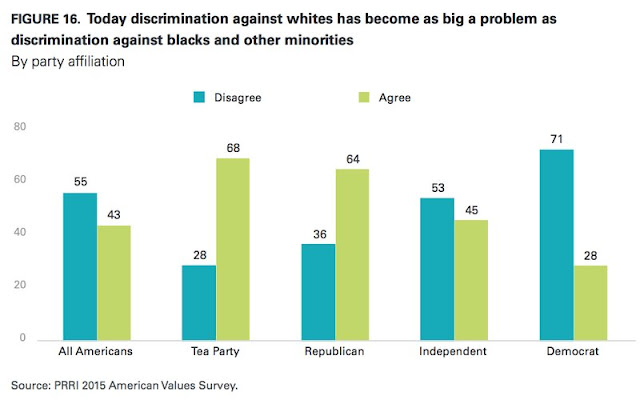
Even if scholars are a bit bored of the fact that the contemporary Republican Party is racist in a way that the Democratic Party is not, the reaction to Donald Trump's rise is a reminder that what is common to knowledge to us is not necessarily well-known to the public. So perhaps we do need to speak up. First, let's just establish the point that the GOP has a severe problem with racism:
There are dozens of data points we might offer as evidence, but I think this is one of the best. It's a simple statement, easy to understand, and because you have to  deny reality in order to agree with it, it's an effective proxy for measuring racial ignorance and racism. Notice, again, that this is a bipartisan problem. Nearly a third of Democrats agree with the statement. But you can see that Republicans have a much more severe problem. Nearly two-thirds embrace a view of American society that is intellectually and morally unsupportable.

You can see this by many other measures too. For example, even attitudes toward interracial marriage have a partisan gap. I'll just note one more. The racial resentment scale that many political scientists use shows how white resentment has become less bipartisan in recent decades and has become increasingly concentrated in the Republican Party.
My intention is not to beat up on the Republican Party. These partisan differences have ebbed and flowed over time. But we do need to grapple with where the problem predominantly exists right now.

I raise this point because I'm concerned that though most Republicans desperately want to stop Trump, they don't appear to have a plan to build their party anew on a less racist foundation. Even now, amid all the denunciations of Trump, the other candidates continue to play to the racism of the base. To understand this, we need to pay attention to what they're not saying.

A few weeks ago, when Marco Rubio finally decided to attack Donald Trump, he got down in the gutter with him, making jokes and personal attacks. He justified this on the grounds that policy attacks didn't seem to stick, and it was the only way to get the media to pay attention. He didn't want to do it, but it was the only option he had, right?

In fact, there has been another attack available to Rubio, Cruz, and Kasich all along, and they could make it without descending to Trump's level or engaging in crude insults or name-calling. This particular attack would also have the virtue of being true. Most important, if made forcefully and unequivocally, this attack would have dominated the news and made headlines for Rubio's campaign. It would go something like this:
"Donald Trump is using racism and bigotry to win votes. It doesn't matter to me whether Donald Trump is a racist in his heart, or is merely playing one on TV. His words are a disgrace to our party and our country, and it is an embarrassment to share a stage with him. I denounce his racism and will campaign against him if he were to be the Republican nominee." 
This would have been the appropriate response from the beginning of Trump's campaign. Remember, he was the most famous provocateur of the birther movement. Then he launched his campaign by calling Mexicans rapists. The other candidates should have pursued this line of attack at the first Republican debate. The point is, if the GOP was as innocent as its leaders claim, this would not have been a hard attack to make! There wouldn't be any downside. But the other candidates can't make this attack because, in the end, they need Trump's voters! And they know that most Republicans, including a substantial number of their own supporters, believe Whites are the primary victims of racism. They know that speaking bluntly against racism will not be received positively by most Republican voters.

The problem is deeper than Trump. And though the Democrats are not as egregious, they have their own problems. The front-runner has expressed her utmost confidence in Rahm Emmanual. She and Bernie have to be pressured and cajoled to support basic justice for people of color. Because so many people of color are in the Democratic coalition, there is a moderating effect. Even though Democrats don't dare to run on an explicit platform of tearing down White supremacy, they do have to be somewhat attentive to minority concerns. In the nearly all-White GOP, the moderating effect is almost non-existent. What Trump shows is that it may be possible to win the Republican nomination while running as a racist. Is it possible to win the Republican nomination while running unequivocally as an anti-racist? None of the other candidates have dared to test that proposition.

Thursday, January 21, 2016

People Are Right to Boycott the Oscars

Some Black artists have chosen to boycott the Oscars after the major award categories featured all-White nomination slates. It is not as though there was a deficit of great Black performances this year, and their exclusion from the awards stage is part of a broader decades-long pattern of discrimination. So the decision to boycott the event is entirely appropriate. But talk of a boycott is producing predictable hand-wringing and questions about the supposed threat to the integrity of the Oscars and of film artistry in general.

"What are the Oscars to do?
 Lower standards?
 Set an artificial quota for films featuring people of color?
 Are we to have affirmative action in movie awards now!!??
 Political correctness!!!!"

Implicit in these questions and complaints is the confident but completely unfounded belief that the Oscars reflect meritocratic achievement. The controversy brings into sharp focus the extent to which White success is coded in our society as earned and natural, even if there is little evidence to support these claims. It is hard to imagine that the people loudly insisting race has nothing to do with this would be so sanguine in a world where Oscar Voters were 94% Black. But here in our real world where they are 94% White, it is obviously inconsequential. By the way, there's nothing sinister or mysterious about this kind of discrimination. The notion that your identity will affect how you experience a film and identify with its characters is too obvious to be seriously denied. But this is, in effect, exactly what defenders of the Oscars do deny.

It is telling that so many people see a challenge to White dominance and Black exclusion as an attack on a meritocracy. Instead of appealing for inclusion of people of color using the language of individual achievement and hard-earned merit, we must expose how the fiction of meritocracy hides the reality of unearned White advantage.

Let's zoom out from movies and think about what we know of the broader structures of opportunity in American society: we know that Whites have race-based unearned advantages in getting jobs and promotions and benefit from network effects. We know that people of color, particularly African Americans, are widely discriminated against in the job market. We also know that discrimination and inequality in education, health, policing, and housing leave many young people of color less prepared for the job market in the first place. We know that these dynamics of unearned advantage and discrimination overwhelm the effects of affirmative action policies. Thus we know that, in the aggregate, successful White individuals are more likely to owe their success to their racial identities than are successful Black individuals. We know this. There's nothing mysterious about it. If we allow ourselves to linger on this point, we will see how dramatically the meritocratic screen distorts our perceptions.

Think about it: though successful Whites are the most likely to experience unearned advantaged based on race, their achievements are most associated with merit, hard work, and earned success. In contrast, achievements of people of color are associated with affirmative action and political correctness. The point is not that people of color never benefit from affirmative action; it is that whites continue to gain far more from our racialized society even as their success is coded as raceless. The idea of meritocracy is deployed in defense of the very group that least exemplifies it.

To be clear, I think it is uncharitable to view any person's success in cynical terms of earned or unearned. On an individual level, few people find great success without putting in a lot of hard work. But the suspicion that attaches itself to Black success ("he's only there because of affirmative action"), would, if applied with any consistency, render White success even more suspicious.

Sunday, January 17, 2016

What is White Supremacy?

White supremacy in the popular imagination
I think it is fair to say that most White Americans scoff at the notion that this is a White supremacist country. And it is easy enough to see why they would do so. After all, we all know what White supremacy is, right? It's that discredited world of white hoods and burning crosses, racial epithets and crude violence. The popular understanding of White supremacy is captured in dictionary.com's definition of the phrase:
the belief, theory, or doctrine that white people are inherently superior to people from all other racial groups, especially black people, and are therefore rightfully the dominant group in any society.
Put another way, the popular understanding of White supremacy is exclusively ideological. According to this perspective, white supremacy is discredited and marginal in American life because there are very few people who subscribe to the ideology that Whites have a racial right to rule. This is true, as far as it goes. The ideology of White supremacy, if expressed in an explicit form, has few supporters. But is ideology the only possible dimension of White supremacy? What about White supremacy as a material condition?

Scholars are increasingly discussing White supremacy as a fact, a condition, a set of systems that structure our lives. Take for example N.D.B. Connolly's recent book, A World More Concrete: Real Estate and the Remaking of Jim Crow South Florida. He writes,
As a system--or set of historical relationships--white supremacy was and is far more than the overtly and occasionally racist act. It includes laws and the setting of commercial and institutional priorities. White supremacy also includes the everyday deals that political operators and common people strike in observance of white privilege or, more accurately, white power...

White supremacy required political, cultural, and business transactions, especially as it related to the meaning and value of real estate in twentieth-century America. The culture driving growth politics in segregated US cities and suburbs, for nearly a century, could not have worked through a simple imposition of so-called white people pressing down on colored people. It required repeated buy-in from people across the class and color spectrums, trade-off after trade-off, year upon year. 
White supremacy in the scholarly imagination
In this scholarly usage, notice that White supremacy is not only a system and set of measurable facts on the ground, it is a system in which people of color participate. In popular usage, the idea that people of color could buy in to White supremacy seems a contradiction in terms. But if White supremacy has a concrete existence beyond ideology, the participation of people of all backgrounds is not only unsurprising, it is historically verifiable.

In the United States in 2016, people identified as White have large and disproportionate shares of wealth, opportunity, and political power, and they live in safer and richer neighborhoods with better access to quality schools, jobs, and public services. This is a statement of fact. You can call it something other than White supremacy if you prefer, but our desire to describe this state of affairs in non-racial terms has nothing to do with clarity or accuracy. Whether we refer to the racial ordering of our society as White supremacy or some other more clunky phrase (systemic White advantage? Disproportionate White power?), it is appropriate and productive to describe it with as much clarity and explicitness as we can.

Yet in popular media and public discourse, it is normal to employ deliberately vague terms that allude to facts but do not actually state or describe them. This is how White supremacy gets translated into terms such as "America's race problem," which can mean whatever you want it to mean, and to many people implies that people of color are the problem! There are two primary reasons for this confusion. First, the traditional ideological understanding of White supremacy remains the default popular usage of the term, and scholars and activists have not yet been able to make their more practical use of the term widely understood, nor have we found a suitable replacement for it. But the second and larger reason for the confusion is that most White Americans do not want to discuss racial conditions in clear and concrete terms regardless of the language we employ. This is a pessimistic take, but it implies that White Americans are not offended by the use of term White supremacy as such, but by the underlying reality to which it calls attention. If your group is at the top of an unjust racial hierarchy, why would you want to draw attention to it?

There is a remarkable inversion at work here. Most Americans understand White supremacy only as an ideology, even as it functions concretely and measurably in fact. Meanwhile, many Americans wishfully interpret colorblindness as a functioning fact, even as it operates primarily on an ideological level. The ideology of colorblindness prevents Americans from seeing the fact of White supremacy. The ideology is rendered as fact and the fact is rendered as ideology.

I welcome any insights and ideas for creative ways to resolve these misunderstandings. Clarity in our language will not in itself fix many Americans' underlying resistance to acknowledging racial inequality and discrimination. Still, it is helpful to understand that when you and I hear the phrase White supremacy, we may be imagining two very different things.

Tuesday, January 5, 2016

America: Where Property Rights > Human Rights

The right to private property is a decisive theme in American history. English colonists disparaged Native claims to land in part because such claims did not align with European conventions of property. Deeds to land, fences, European-style cultivation--all these signaled the arrival, so the English thought, of civilization itself. If the right to private property implied civilization, the right to a particular kind of property (in human beings) marked its owners as free people. In attempting to turn people into chattel, White Americans demonstrated in no uncertain terms the value they placed on private property, and the lengths they were willing to go to secure their own liberty, as they understood it. After the Civil War, property in people may have been (partially) abolished, but property in land remained as vital as ever. The federal government honored the land claims of former Confederates over the demands of freedpeople. Private property--even of those who made war against the state--was sacrosanct; the value of human lives less so. For the next century and beyond, the promise of the so-called American Dream was always, at bottom, a promise of property. It was a promise that people of color, seeking to claim, frequently found wanting. In a country where Whiteness itself became a kind of property, America's obsession with private ownership played out along hierarchical racial lines.

From a Christian perspective, private property in American history has been nothing short of an idol in the mosaic sense--a false god that leads the hearts of the people astray. The idolatry is all around us as we speak. Exclusionary zoning, gated communities, flight from public schools--all these hurt the poor, but serve the interests of property holders. The idolatry infects our moral reason too. I encountered a startling example of this reasoning in response to two recent news events.

David French, a writer at National Review magazine, has offered his take in recent days on the Tamir Rice grand jury decision and on the militia standoff in rural Oregon. You already know where this is headed, but let me share with you the title and an excerpt from the respective pieces. First, the Tamir Rice case: "The Grand Jury Made a Defensible Decision not to Indict in the Tamir Rice Case."
It was not the officers’ fault that they rolled up on the scene without that key piece of information [from the 911 call]. Thus, the officers were reasonably on a much higher state of alert. Then when Rice didn’t put his hands in the air despite shouted commands to do so — but instead seemed to reach into his waistband — their decision to open fire is rational, not criminal... 
[I]t’s difficult to second-guess a grand jury who sees no basis for subjecting those officers to a criminal trial.
Second, the Oregon militia: "The Case for Civil Disobedience in Oregon."
Deranged militiamen spoiling for a fight against the federal government make for good copy, but what if they’re right? What if the government viciously and unjustly prosecuted a rancher family so as to drive them from their land? Then protest, including civil disobedience, would be not just understandable but moral, and maybe even necessary... 
I sympathize with the ranchers’ fury, and I’m moved by the Hammonds’ plight. According to multiple accounts, they are good American citizens... 
They are victims of an all-too-common injustice. Ranchers and other landowners across the country find themselves chafing under the thumb of an indifferent and even oppressive federal government. Now is the time for peaceful protest. If it gets the public to pay attention, it won’t have been in vain.
(For the record, as far as I can tell the prison terms meted out to the Oregon ranchers are absurd and unjust. The Federal Government seems to be wrong here.)

The Oregon militia protest is more extreme and threatening (they're armed and occupying a federal building!) than any Black Lives Matter protest thus far. Its proximate cause is a convoluted property dispute. The stakes (of property) are much lower than those (of life) that stirred Black Lives Matter protests, yet the militia's tactics are more militant. Nonetheless French, a good law and order conservative, finds a way to sympathize with this militancy.

There are a lot variables at play in French's writing. He may be influenced by a sense of ideological and racial affinity, and both cases have heavy political overtones. The mistake is in thinking that any of these variables are fully separable from the American obsession with property. I'm not here to beat up on Mr. French. His thought is emblematic rather than exceptional. He represents an American tradition: the peculiar faith that ownership of private property is a supreme good, even if securing that property comes at the cost of human life.

For French, an overzealous enforcement of federal property protection laws is a grave injustice worthy of armed (but peaceful) civil disobedience. He is "moved" by the ranchers' sufferings and can "sympathize" with their anger. Landowners are at the mercy of an "indifferent" and "oppressive" federal government. But when state employees slaughter a twelve year old boy without practical warning and refuse to render medical aid (Notice French couldn't even be bothered to give an accurate accounting of the event), French serenely assures us that their behavior was "rational." The state has killed a twelve year old boy, but it would be "difficult" to second-guess a rigged grand jury process.

French's words of support for the ranchers are ten times more generous than anything he's been willing to concede in his many critiques of Black Lives Matter, and a hundred times more empathetic than the shallow dehumanization he offers for victims of state-sponsored murder. 

The engrained idolization of White property ownership allows writers like French to casually express dehumanizing racism and remain members in good standing of the respectable pundit class. And we enable it when we scrutinize every slip of the tongue and poorly-conceived joke ("Gasp! A racist! Get 'em!") but fail to probe the deeper idols and systems that implicate us all. What role does property play in my life? Do the righteous demands of my fellow human beings take precedence over my grasping desire to own, control, accumulate? Every battle over public housing in my neighborhood or tax increases for public schools compels me to consider whose interests come first. Every time I don't want to invite that person into my house again because last time they broke something, I'm grappling with the idolization of property over people. Every commute, every wary smile and mumbled "sorry" as I pass the homeless man on the corner, should impress on me these questions.